Hello, I'm
Touhidul Islam Rukon
IT Systems & Operations Lead · Web Developer · Software Specialist
I work across IT systems, operations, web and software: understanding an operational problem, designing the system for it, building and deploying it, then supporting and improving it once people depend on it daily. RPOMS, an ERP-style operational platform running a live router-refurbishment line, is the clearest example.
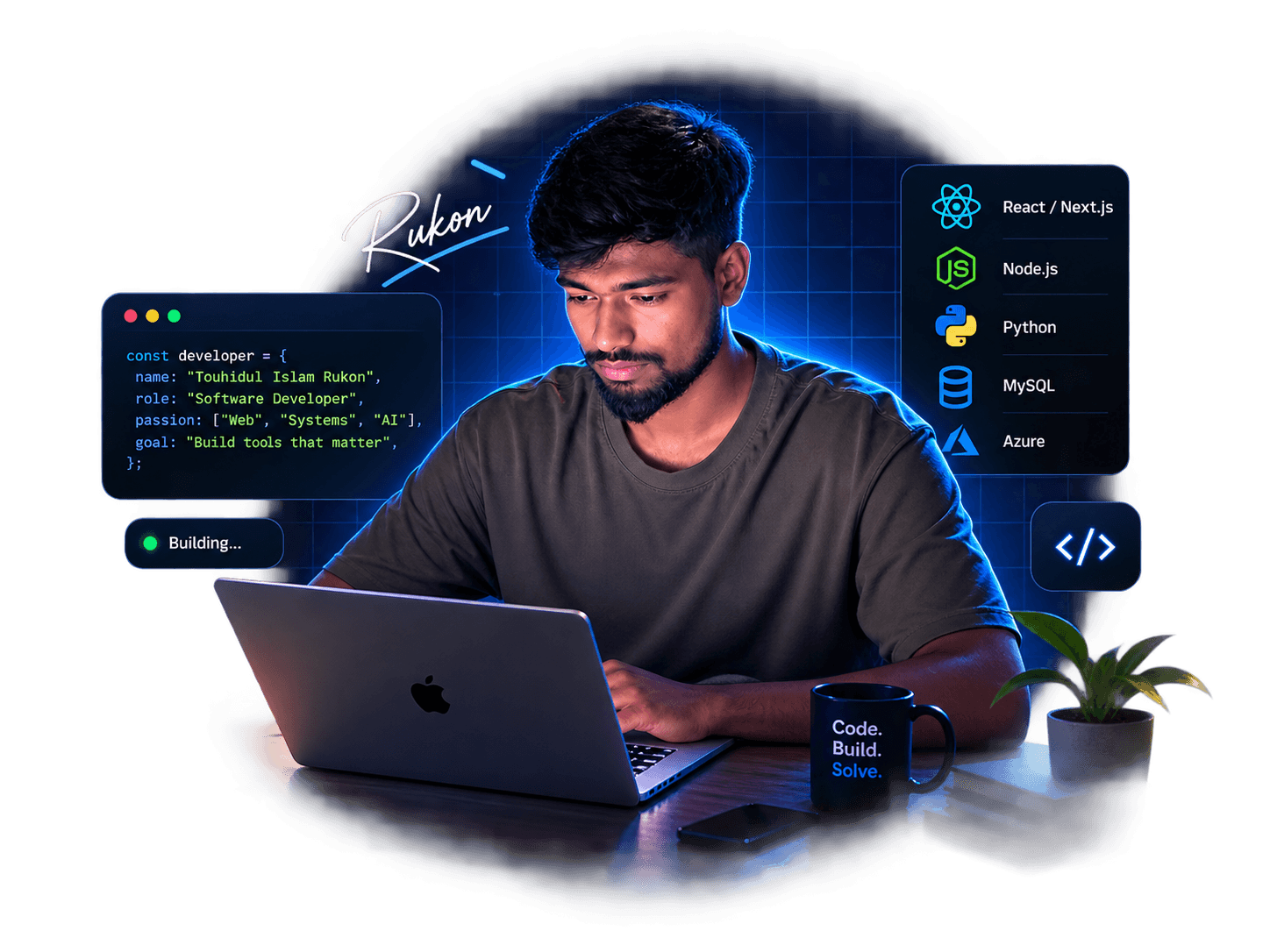
Real systems, not tutorials.
An ERP-style operational system running a live production line, a completed business website, and a deployed AI research assistant.


Where my work sits.
Grouped by the kind of problem rather than by technology. Each one names the project it comes from.
IT Systems & Operations
Running the systems a business depends on daily, including the ones I build: deployment and environment configuration, secret management, production issue resolution, user and technical support, hardware diagnosis and repair, system installation, and keeping it all working as requirements change.
EvidenceRPOMS
WMS / ERP-style Operational Systems
Turning a physical operation into one system: asset and serial tracking, inventory and consumable deduction, production stages, delivery, workforce output and operational reporting, all reading from a single data model so a dashboard figure traces back to the event behind it.
EvidenceRPOMS
Web Development
Building the actual website: semantic HTML, CSS that holds up from 320px, and only the JavaScript a page needs. A production homepage shipped as static files with no third-party requests, application interfaces in React and Next.js, and WordPress, Elementor and WooCommerce maintenance on company web properties.
EvidenceERTHRPOMSResearchForge
Business Requirements to Working System
Taking a requirement from the people doing the work rather than from a specification, deciding what the system has to model, building it, putting it into use, and correcting it once real use exposes what the requirement left out.
Full-Stack Web Development
End to end in TypeScript and Python: interfaces, API routes, data models, and the deployment path to production. Next.js App Router on the front, Next.js route handlers or FastAPI behind it.
EvidenceRPOMSResearchForge
AI & LLM Engineering
Shipping an LLM feature that behaves: groundedness enforced in four layers rather than requested in a prompt, output validated against a declared schema and discarded rather than repaired when it fails, and a provider abstraction with a narrow, whitelisted automatic fallback.
EvidenceResearchForge
UI/UX & Design-to-Code
Working an interface out as a Figma prototype before implementation (structure, visual direction and user flow), then translating that prototype into a production build without losing the intent.
EvidenceERTH
Technical SEO & GEO Implementation
Implementing search requirements at the code level: metadata, canonicals, structured data, heading hierarchy, semantic HTML, and content structured so an answer engine can quote a section and still be right.
EvidenceERTH
Web Performance & Accessibility
Making a page cheap and usable: self-hosted fonts, images re-encoded and sized so nothing shifts, landmarks and focus management, keyboard-operable dialogs, and reduced-motion honoured rather than assumed away.
EvidenceERTH
Data & Database Systems
Schema design in PostgreSQL and MySQL, a storage interface with interchangeable backends, row-level access control, and deriving figures from a full history rather than storing totals that cannot be traced.
EvidenceRPOMSResearchForge
System Architecture
Choosing where a decision lives: one chokepoint rather than a check per route, one interface rather than a vendor dependency, one copy of a rule rather than two that can disagree.
EvidenceRPOMSResearchForge
Document Processing
Ingesting real files rather than clean ones: signature verification, encryption handling, conservative text cleaning, and generating documents that match a format someone's process already depends on.
EvidenceResearchForgeRPOMS
Business Process Automation
Turning manual, error-prone repetition into software: one entry that updates everything downstream, staged imports that surface problems before they are written, and paperwork generated rather than retyped.
EvidenceRPOMS
Where the work happened.
IT Systems & Operations Lead · Web Developer · Software Specialist
Blue Bee Technologies Sdn. Bhd. · Cyberjaya, Malaysia
One role covering the whole chain: operational requirement, system design, web and software implementation, deployment, daily support, and ongoing maintenance. Lead for RPOMS, the ERP-style operational system running the company's router-refurbishment programme.
- Lead RPOMS end to end: gathered the requirement from the production floor, designed the data model and three-tier access control, built ten admin modules and twenty-five API routes, took it to production, and remain its maintainer.
- Built RPOMS as a real operational system rather than a reporting tool: serial-level asset tracking, inventory and consumable deduction tied to valid business events, packing and delivery validation, generated delivery paperwork, workforce output, and operational dashboards.
- Work directly with the operation the system serves, the ERTH x Maxis refurbishment line, its stock and the people running it, so the software's rules come from how the floor actually works rather than from an assumed process.
- Built the ERTH production homepage: prototyped in Figma, then implemented from the approved design as static HTML, CSS and vanilla JavaScript, with technical SEO, structured data, performance and accessibility delivered in the same pass.
- Maintain company web properties, including WordPress development, Elementor page design and WooCommerce setup, from requirement through to deployment and ongoing upkeep.
- Provide day-to-day IT support and operations: troubleshooting the internal business tracking system and other software, hardware diagnosis and repair, system installation, and maintenance of PCs and IT equipment.
- Handle deployment and environment work across Vercel, Supabase and cPanel hosting, including configuration, environment and secret management, and resolving production issues as they surface.
Technical Lead
University of Cyberjaya IT Society · Cyberjaya, Malaysia
Technical planning and on-site support for IT Society events.
- Coordinate technical planning for IT Society events and provide on-site support to keep them running smoothly.
- Assist with organizing and managing IT-related events, working across teams to deliver programs.
Developer, ResearchForge (University Project)
University of Cyberjaya, BIT4543 Artificial Intelligence · Cyberjaya, Malaysia
A university project developed as part of BIT4543 Artificial Intelligence, taken end to end: initial documentation and planning, system specification and architecture, development, AI integration, database and security engineering, testing, deployment, debugging and ongoing maintenance. The result is a live AI research paper assistant on my own domain and repository.
- Started with documentation rather than code: the first commit is the project structure, working rules, a project plan with milestones and risks, numbered technical decisions and the environment contract. Milestones and risks were tracked and closed in the repository as the project ran.
- Designed the system: two services in one Vercel project behind a single origin, a provider interface keeping vendor SDKs out of the analysis code, the PostgreSQL schema and its migrations, and the API surface with its error semantics.
- Built both sides: a Python and FastAPI backend with the analysis pipeline, PDF ingestion, caching and owner configuration, and a Next.js frontend covering the landing page, authentication flows, analysis workspace, research library and cross-paper review.
- Moved per-user data isolation out of application code and into PostgreSQL Row Level Security, after finding that a privileged database key had left every correctly written policy inert while all tests still passed.
- Constrained model output to a declared schema, validated it on return, and discarded anything that failed rather than repairing it, so the application never renders a partially valid analysis as though it were complete.
- Wrote the test suite: 522 backend tests passing with pytest and 16 frontend tests with Vitest, none of which call a paid AI interface, plus live scripts for the isolation guarantee a stubbed test cannot verify.
- Deployed and maintained it: production and environment configuration, then debugging real failures, including a CDN that replaced provider error bodies with a generic message and hid the finding behind the whole evaluation, and a schema change that broke every library read until the queries were made to degrade one migration level at a time.
Tools I build with.
Tiered rather than listed flat. Appearing in a dependency file is not the same as having built something substantial with it.
Primary
What I reach for by default, and have built and shipped production systems with.
Working
Used substantially across more than one project.
Project-specific
Chosen for a particular problem, and used properly for it.
Supporting
Part of the work, at a maintenance, operational or foundational level.
Learning
Genuinely in progress. Listed because it is honest, not because it is finished: I use these, and I am still deepening them.

Touhidul Islam Rukon
IT Systems & Operations Lead · Web Developer · Software SpecialistI'm a hands-on technology professional in Cyberjaya, Malaysia. My work sits where three things meet: the operational problem a business actually has, the system built to solve it, and the day-to-day support that keeps it working once people depend on it.
That means I'm rarely doing only one of those jobs. I write the software, but I also gather the requirement from the floor rather than a specification, deploy it, support the users, troubleshoot the hardware and software around it, and keep improving it after launch. The technical work and the operational work are the same job.
RPOMS is the clearest example. It's an ERP-style operational system I designed and built for a router-refurbishment programme at Blue Bee Technologies, and still maintain: serial-level asset tracking, inventory and consumable deduction, packing, delivery and paperwork generation, workforce output, operational dashboards and reporting, and three-tier access control. Around 35,800 lines of TypeScript across ten admin modules and twenty-five API routes, replacing the spreadsheets the operation used to run on.
On the web side, I prototyped the ERTH homepage in Figma and then built the production website from the approved design: static HTML, CSS and vanilla JavaScript on Vite, with the technical SEO, structured data, performance and accessibility work in the same pass. Alongside that I maintain the company's web properties, including WordPress, Elementor and WooCommerce work.
ResearchForge is where the software-engineering side goes deepest: a university project for BIT4543 Artificial Intelligence that I took from planning documents through to a deployed, maintained AI research assistant, with a Python and FastAPI backend, a Next.js frontend, per-user data isolation enforced by PostgreSQL Row Level Security, and a test suite that never calls a paid AI interface.
I'm completing a B.Sc. in Information Technology at the University of Cyberjaya. My TypeScript and newer platform work is something I'm deliberately still deepening rather than treating as finished. I'm open to roles across IT systems and operations, web development and software.
- Location
- Cyberjaya, Selangor, Malaysia
- Degree
- B.Sc. Information Technology (in progress)
- Status
- Open to opportunities
- Languages
- English, Bengali, Hindi, Urdu
From problem to production.
Understand
Understand the business, the operational environment, and the actual problem, not just the requested feature.
Plan
Define the system, workflow, interface, or data structure the problem actually needs.
Build
Design and develop the software, website, or workflow.
Deploy & Improve
Test, deploy, support, and maintain the system, then keep improving it as requirements change.
This isn't the same for every project. For an operational system like RPOMS, understanding starts on the floor: the physical process comes first, then the operational requirement it creates, then the system built to meet it. The software is one step in that chain, not the starting point. See how in the RPOMS case study.
Education
B.Sc. in Information Technology
University of Cyberjaya, Malaysia
2024 - 2027 (expected) · In Progress
B.Sc. in Computer Science & Engineering
Daffodil International University, Bangladesh
2024 · Completed
Higher Secondary Certificate (Science)
Milestone College, Dhaka, Bangladesh
2023 · Completed
A few questions people ask.
What does Touhidul Islam Rukon build?
Websites and the internal systems a business runs on, plus the IT operations around them. The main three are RPOMS, a production-operations platform for a router-refurbishment line; the completed production homepage for ERTH, a Malaysian e-waste collection service; and ResearchForge, an AI research assistant that analyses academic PDFs. Based in Cyberjaya, Selangor, Malaysia.
What is RPOMS?
RPOMS is a Router Production Operations Management System built for a refurbishment programme run by Blue Bee Technologies. It covers the full path a unit takes, from intake and serial registry through cleaning, packing into numbered boxes, and delivery with matching paperwork, across ten admin modules and twenty-five API routes in TypeScript, with a storage layer that runs on PostgreSQL, MySQL or a local file store. I designed and built it and remain its maintainer.
What is ResearchForge?
ResearchForge is an AI research assistant. Upload an academic PDF and it returns a structured summary, a research-gap analysis where each gap carries the evidence in the paper that supports it, and a literature review of the prior work that paper discusses. It runs a Python and FastAPI backend beside a Next.js frontend as one deployment behind a single origin, with accounts, a private per-user library whose isolation is enforced by PostgreSQL Row Level Security, and 538 passing tests that never call a paid interface. It was developed as part of BIT4543 Artificial Intelligence at the University of Cyberjaya, and I took it end to end: planning documents, architecture, both sides of the implementation, testing, deployment, debugging and maintenance.
Does ResearchForge use RAG or retrieval?
No. The analysis path sends the document itself to the model rather than retrieved passages, so it is not a retrieval-augmented system. A database is connected and analyses are stored in a per-account library, but the retrieval layer is not: the embedding provider interface and request construction are written and unit-tested, while the embedding network call is deliberately not implemented, so no embedding is ever produced and nothing is retrieved. The application states this rather than implying otherwise.
What was your role on the ERTH website?
Two phases, and the work is complete. The interface was prototyped in Figma before implementation. The production homepage was then built from the client-approved design as static HTML, CSS and vanilla JavaScript bundled by Vite, which replaced roughly 250 kB of prototype JavaScript with 3.7 kB, cut the image payload from 12.0 MB to 2.7 MB, and fixed four real defects the prototype carried. Technical SEO, structured data, performance and accessibility were implemented in the same pass: the head block went from no canonical, no Open Graph and no structured data to all three, with three JSON-LD blocks, and axe-core reports zero violations across five interaction states.
Is Touhidul Islam Rukon a web developer or an IT operations lead?
Both, and the two sides feed each other. The web development side is production websites and application interfaces in HTML, CSS, JavaScript, TypeScript, React and Next.js. The IT operations side is running the systems a business depends on day to day: deployment, configuration, troubleshooting, hardware and equipment, and web property maintenance. On RPOMS the roles are the same job, because the system models a physical production line and its rules come from the floor rather than a specification.
What kind of systems do you work on?
Mostly internal business and operational systems such as production tracking, inventory, and admin and reporting tools, alongside AI applications and customer-facing websites. The common thread is software that has to stay in step with a real process rather than software that only has to manage records.
Do you build full-stack applications?
Yes. Frontend, backend, database and deployment. RPOMS is built and run that way end to end in TypeScript, and ResearchForge pairs a Python and FastAPI backend with a Next.js frontend.
Do you do technical SEO work?
Yes, at the implementation level: metadata, canonical URLs, Open Graph and Twitter cards, Schema.org JSON-LD, heading hierarchy, semantic HTML, internal linking, and structuring content so an answer engine can quote a single section and still be correct. On the ERTH homepage this was delivered as part of the production build, against a supplied requirements document and without changing the approved design.
Where are you based?
Cyberjaya, Selangor, Malaysia. I work with businesses across the Klang Valley and remotely.
Are you available for software or web development opportunities?
Yes. I'm open to web development and IT operations roles, internship or full-time, and I'm reachable by email or WhatsApp.
From the blog.
Have a system, website, or operational workflow that needs to be improved?
I'm open to internship and full-time software engineering opportunities. Reach out directly, or use the form.